en
.svg)

At the Green Power Sweden Summit on October 14, the Peerpointing initiative and Renewable Sweden held an appreciated Power Talk about a newly launched report on innovative and important anchoring work for renewable energy.
Results that are hard to ignore
Je Misconceived Headwind 2025. Ne una kamera telefonica celular je v poștal de l'audienca como os conclusiones de iniciativo se predável por um:
1. Púltima desidera más poder do vento en su municipio -- pero no pensar.
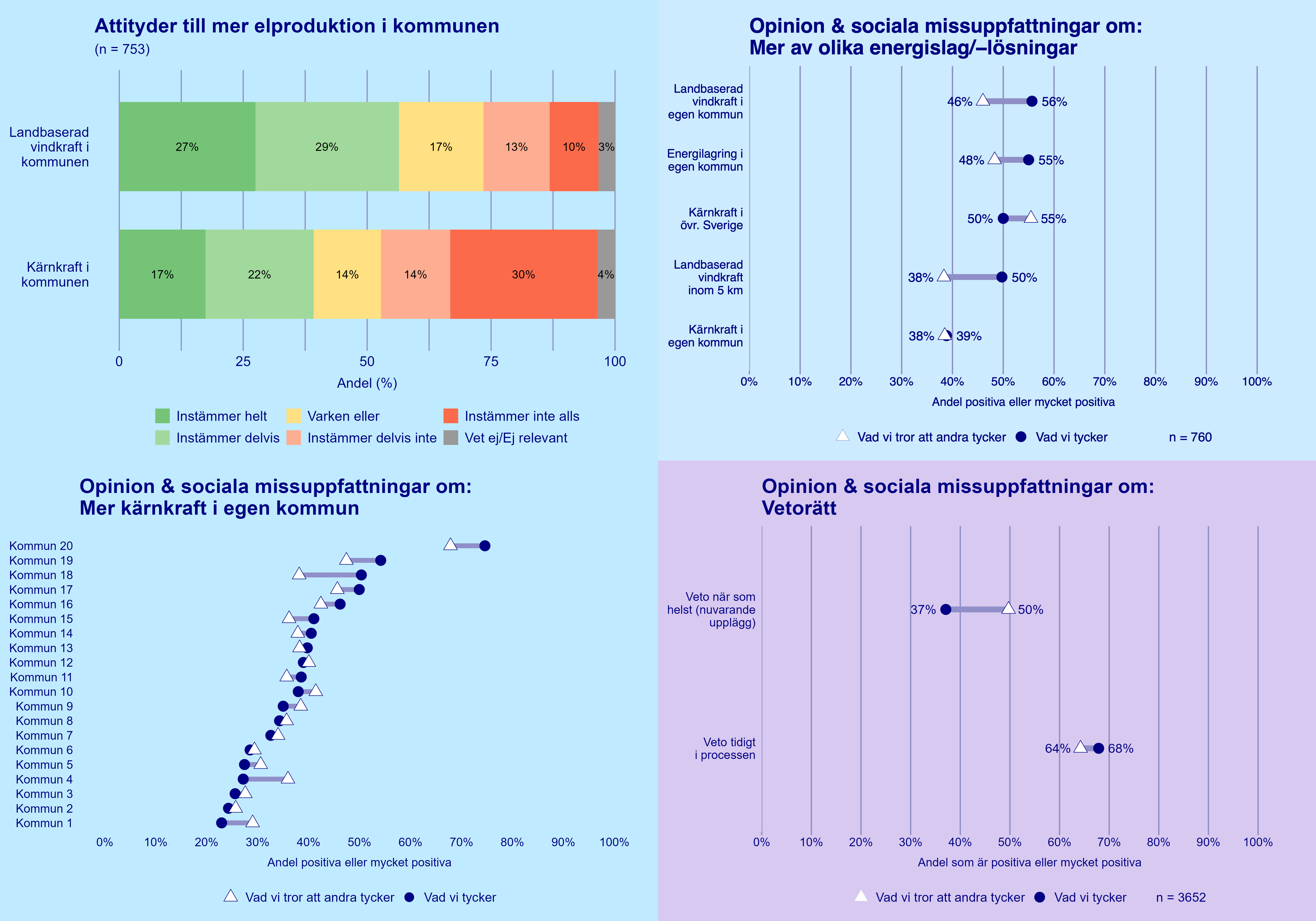
På projekt (760 svar), 56% v. In the context of opinion, ten percentage points is always a significant gap, and the perceived minority-defying actual-majority dynamic makes the discrepancy even more problematic.
For the thirteen municipalities that the project focused on (around 500 responses in each), the perception gap was smaller in some and larger in others, but it existed in all. V.
Höganäs a Varberg, Höganäs a Varberg, Falkenberg, Halmstad, Höganäs a Varberg.
2. We particularly underestimate the support of rural people.
Most of the misconception above is driven by an underestimation of what people outside of urban areas think about more wind power. Na nazionale livello, supporto per questa gruppo je 43%, mentre la percepción del supporto era solo 30%. Så,.
Se, 56% v 1. For rural residents, that figure was 37% — a lower proportion than the aforementioned 43% positive.
3. Supporto per il veto del vento municipalo in forma corrente è credo a alto, ma è più basso.
Only 37% of respondents at national level want to keep the current design on the veto, but Swedes believe that 50% want it. Věsto v 97%. Supporto è alta -- 68% -- per reforming la veto, che solo municipiali in il processo può essere l'applicazioni da essere in grado di stato. O progetto no realmente mispercepción sociales sobre esta podría, con un supporto percional de 64% en medio.
4. Local politicians, if anything, seem to have an even worse understanding of the state of opinion.
The project also invited municipal politicians to respond to a customized version of the web survey. Compared to the gold-standard procedure for selection and recruitment used for the general public — randomization, stratification, mixed methods of invitations (mail, SMS, Kivra), weighting — this target group was invited only by email. As expected both from this reality and from experience with other, more expensive methods, the response rate among politicians was low: 13% compared to 28% for the general public. Hence the word “seems” in the headline.
However, the patterns of 222 responses from the thirteen municipalities mentioned are nevertheless interpreted as strongly indicative because they closely mirror public performance — including the underestimation of support for more wind power locally. If anything, the voters' representatives seem to harbor greater misconceptions of voters' opinions than the voters themselves do which is very problematic. These findings are also in line with, for example, robust British and German research on many different issues arriving at the same conclusion, that politicians tend to have greater social misconceptions than the general public.
5. Problem/Opportunity is greater for some types of power (especially wind power) than for others (e.g. nuclear).
While the project saw consistent underestimations of support for wind power, the case was not the same for nuclear. Por vento, o modelo je zelo: v todos 20 municipios, dove o progetto recibido grande samplo, a medio de 50 resposta mais, no se uma única overestimación na livello municipale. When it comes to support for new nuclear power in one's own municipality, the pattern instead looked random and the perception gap was much smaller. Two percentage points underestimation there, three percentage points overestimation there.
This means that, for some reason, the Swedes have a much better understanding of people's attitudes about nuclear power than of their attitudes about wind power. Obvious candidates for contributory causes are misinformation and a well-organised opposition that manages to capture a disproportionate amount of attention. This is not good, of course, but it also means that the dominant narrative in (social) media in Sweden does not accurately reflect what the public as a whole actually thinks, so if we dispel the fog, there is room for rapid improvement.
Projekt, samo med Indicator Opinion, data fra, av en. Progetto je je v Peerpointing initiative, se je na v Tim Isaksson.
Renewable Sweden did not participate formally, but provided input and contacts to the project in spring. Gå ().
Social misconceptions are far from innocent curiosities
Tim explained that several problems arise when we have inaccurate images of what our fellow human beings or constituents think. Se vi,. Misconceptions can also lead to people changing their opinion “unnecessarily”, in order to conform to what is believed to be the majority opinion. Som
In other words, social misconceptions can lead us not to build the society we actually want. Some might say “OK, we don't really know what the neighbours think, it's not that surprising, is it, what's the deal?”
But from a larger perspective, it will be a most real democratic deficit. Research on social diffusion and social movements shows that even seemingly small shifts in perceived opinion can catalyze large mobilizations on issues ranging from international armed conflict to family politics. If public support for positive change is systematically underestimated, what major transformations for a better world are completely unnecessarily hindered? Social misconceptions thus pose a non-negligible threat to progress wherever they arise. Given the climate crisis and the pace of change we need, they also contribute to contemporary and future suffering from the consequences of climate change.
What does this mean for the renewables sector in Sweden and beyond?
Jeanette Lindeblad, founder and CEO of Renewable Sweden, started the draw by stating that the increasingly non-linear permit processes pose new challenges for acceptance work, especially when it comes to securing permits for new wind power. La experiencia del compañía é que nuevos approches necesita a convincar políticos municipales como el público general que más residentes se passively giving their strong mandate for the expansion, but are drowned out in the debate and then not primarily by legitimate concerns from local residents.
Presenting opinion polls in a new packaging can be a valuable tool in that effort, Jeanette continued. Kombinad med responsiv citizen-dialogue och outreach knowledge-building services — moderne visualisation — som, vi kan.
Tim ended the esteemed and insightful quarter-long session by agreeing with the need for new ways to communicate. Het industrie is having a very tough time right now and one of the pieces of the puzzle ahead may be seizing the interesting opportunity that the social misconceptions entail after all. Perché está existente, baros “fruits de accepción” para seleccionar en el cambio climático — nuevo persuasion es muy não necesita. Så. Stap twee is to get the silent majority to dare to make more of a fuss of themselves, by broadly communicating the positive social norms.
Many in the audience afterwards wanted to talk to Tim and Jeanette about ways forward. We welcome anyone interested to hear from you to find ways to collaborate. Because it is urgent that we make progress on this. Nästa,. Our answer: they are unlikely to diminish by themselves.
LINKS: